
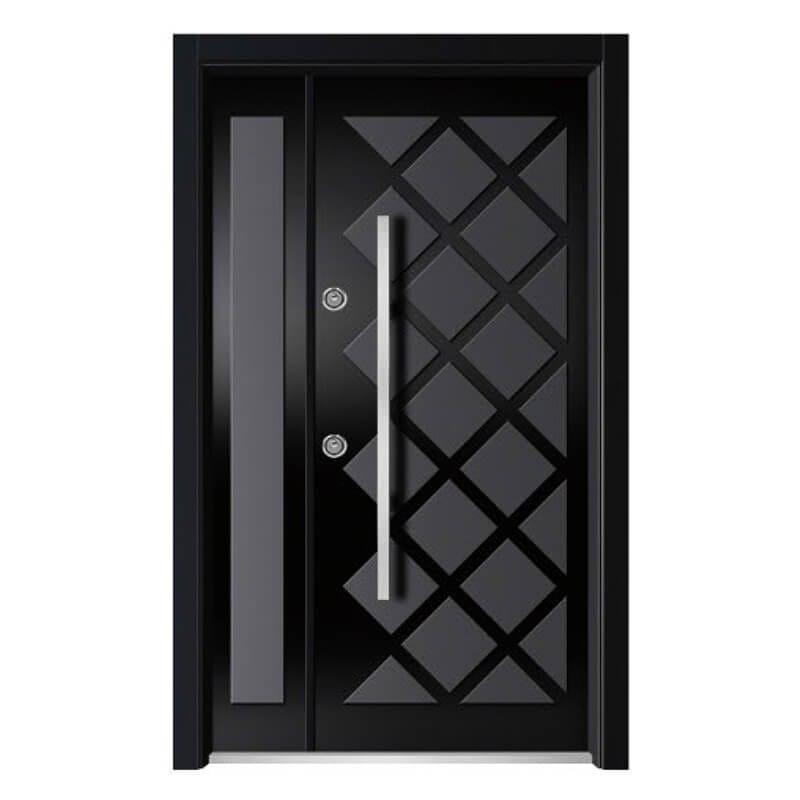
What is the difference between a security door and a regular door?
A security door is specified with resistance to unauthorized entry as an explicit objective. A regular door may primarily provide access, privacy, appearance or separation between spaces. These descriptions are not performance grades. Either door can have different materials, cores, frames and hardware; verify the actual door-set specification instead of assuming all regular doors have hollow cores or all security doors have the same construction.The leaf, frame, locking arrangement, hinges, glazing where present, anchors and supporting wall need to be considered together. If a project requires a tested classification, request evidence that covers the proposed configuration, dimensions and installation conditions. A lock certificate should not be presented as a whole-door test result.A practical comparison for procurement teams
| Comparison item | Security-focused specification | Regular-door specification | Evidence to request |
|---|---|---|---|
| Intended location | Define the entrance risk and access requirements. | Define privacy, circulation and appearance needs. | Opening schedule and room or entrance reference. |
| Leaf and frame | Confirm the construction of the complete proposed set. | Confirm construction without inferring it from the style. | Model-specific drawings and agreed material schedule. |
| Hardware | Coordinate locks, hinges, keep locations and any access-control interfaces. | Coordinate the hardware needed for the intended use. | Hardware list, compatibility details and maintenance instructions. |
| Installation | Check the frame fixing, supporting wall and installer responsibilities. | Check opening preparation, fitting and alignment. | Installation detail and scope allocation. |
| Required performance | Identify any project-specific security evidence required. | Identify any project-specific performance evidence required. | Applicable reports for the actual configuration, not a generic brochure statement. |
| Purchase scope | List every included component and service. | Use the same list so quotations are comparable. | Itemized quotation and written exclusions. |
Compare cost without relying on a universal price range
Prices depend on dimensions, construction, finish, hardware, quantity, packing, destination and installation scope. A leaf-only quotation cannot be compared directly with a complete set that includes a frame, threshold, seals and hardware. KEST pricing should be requested for a defined specification; this guide does not publish indicative product prices.Build a comparison with separate lines for the door set, optional hardware, samples, packing, freight, destination charges and installation. Include duties or taxes only after confirming the destination and the agreed delivery terms with the relevant providers. Do not assume that a supplier quotation includes every part of the delivered and installed cost.For a structured starting point, use the steel security door RFQ checklist for importers. Compare alternative quotations against the same dimensions, quantities, finish approval and supply boundary.Durability, maintenance and insurance: what to verify
Service life and maintenance depend on the particular finish, exposure, hardware, fitting and care regime. Ask for written maintenance instructions and the actual warranty terms. Do not infer corrosion resistance, thermal insulation, acoustic performance or fire resistance from the word “security”; each requires its own appropriate evidence when specified.There is no universal insurance discount or guaranteed increase in resale value for installing a security door. Ask the property insurer whether the exact proposed product, evidence and installation meet any conditions for the individual policy. Include savings in a project calculation only when independently confirmed, and keep them separate from the supplier’s product quotation.Copyable project brief for an informed comparison
- Project and destination: country, city and whether this is a villa entrance, residential development or hotel project.
- Opening schedule: door IDs, quantities, measured openings, wall construction and finished floor level.
- Configuration: single or double leaf, opening direction, frame, threshold and any glazing.
- Design approval: finish reference, sample requirements and the person responsible for approval.
- Hardware: preferred lock and hinges, access-control interfaces and any separately supplied items.
- Evidence: project-specific requirements and reports that must be checked before selection.
- Supply boundary: packing, shipment destination, installation responsibility and the required quotation breakdown.